First of all, Dewi read your blog entry but she did not take your book "Banker to the Poor: The Story of the Grameen Bank". But Dewi agrees that your suggestion to her is a good one. She has been following the news of Mohammad Yunus for a while now, and was really elated when his contribution to the world was recognised when he won the Nobel Peace Prize and one of the Asian Heroes by TIME Magazine. Dewi is pleased to know that you know the kinds of books that she likes to read. You were right to recommend Banker to the Poor, and she has ordered it from Amazon.co.uk this morning to be sent to her friend's London address. Meanwhile, apart from the cover you posted on your blog entry, here are the other covers of the same title:
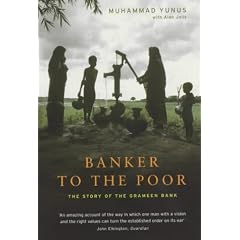
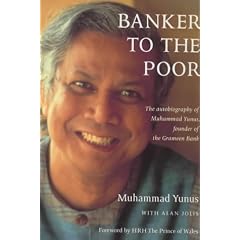
Muhammad Yunus set up the Grameen Bank in his home country of Bangladesh with a loan of just GBP17 or USD27, to lend tiny amounts of money to the poorest of the poor - those to whom no ordinary bank would lend. Most of his customers - as they still are - were illiterate women, wanting to set up the smallest imaginable village enterprises. It was his conviction that this new system of 'micro-credit', lending even such small sums, would give such people the spark of initiative needed to pull themselves out of poverty. Today, Yunus's system of micro-credit is practised around the world in some 60 countries, including the US, Canada and France. His Grameen Bank is now a billion-pound business. It is acknowledged by world leaders and by the World Bank to be a fundamental weapon in the fight against poverty. "Banker to the Poor" is Yunus's enthralling story of how he did it: how the terrible famine in Bangladesh in 1974 focused his ideas on the need to enable its victims to grow more food; how he overcame the sceptics in many governments and among traditional economic thinking; and how he saw his micro-credit extended even outside the Third World into credit unions in the West. Such is the importance of his book that HRH the Prince of Wales has contributed a Foreword in which he hails 'a remarkable man [who] spoke the greatest good sense'.
One of the readers of this book reviewed: "After reading Yunus's book, I was quite skeptical that it could all be true. So I decided to go to Bangladesh and find it out for myself. I spent one month both in the headquarters in Dhaka and living in the branches in rural areas. I documented do[z]ens of testimonies from borrowers and proved the book was telling the tru[th]."
Another said: "Mohammed Yunus's inspiring autobiography tells how he founded the Grameen microcredit bank and lifted millions of people out of poverty. A must-read for anyone interested in relieving hardship in the developing (and developed) world, and a savage critique of the conventional politics of charity and aid. A strong believer in socially-responsible business, Yunus uses social structures to do away with red tape and legal process and yet achieves a 98% repayment rate on loans. Whether your politics are left or right, this book is compelling and profoundly moving."
Mohammad Yunus's achievements were also explained in the book Dewi is currently reading, "The End of Poverty: How We Can Make It Happen in Our Lifetime" by Jeffrey Sachs, the man currently running to be the next President. Maya, when Dewi ordered the book from Amazon.co.uk, she also ordered "Development as Freedom" by world-known economist Amartya Sen.
Thanks for recommending the book, and for understanding her.
xoxo Angel-jan


